
Understanding AI Investment
Artificial Intelligence (AI) investment is growing rapidly as businesses worldwide adopt smart technologies. Investors are focusing on AI companies because AI is transforming industries like healthcare, finance, education, cybersecurity, and digital marketing.AI investment includes funding AI startups, buying shares of AI-focused companies, and supporting new technologies such as machine learning, automation, and robotics. Major tech companies like OpenAI, NVIDIA, and Google continue to lead the AI market with innovative products and services.One key reason AI investment is popular is the increasing demand for automation and data-driven solutions. Businesses use AI to improve efficiency, reduce costs, and enhance customer experiences.However, investors should also understand the risks. AI markets can change quickly, and competition is strong. Researching market trends and company performance is important before investing.As AI technology continues to evolve, experts believe AI investment will remain one of the most promising opportunities in the global technology sector.
The Advantages of AI Investment
Artificial Intelligence (AI) investment is becoming one of the fastest-growing opportunities in the technology industry. Businesses and investors are increasingly focusing on AI because it offers long-term growth potential and innovation across multiple sectors.One major advantage of AI investment is high market demand. Companies worldwide are adopting AI-powered solutions to improve productivity, automate tasks, and enhance customer experiences. Industries such as healthcare, finance, education, and e-commerce are rapidly integrating AI technologies into their operations.AI investment also provides opportunities for strong financial returns. Leading companies like NVIDIA, Microsoft, and OpenAI are driving innovation and attracting global investors.Another key benefit is future scalability. As AI technology continues to evolve, businesses using AI can expand faster and remain competitive in the digital economy. AI can also reduce operational costs by automating repetitive work and improving efficiency.Despite some market risks, AI investment remains attractive because of its rapid growth and long-term potential. Experts believe AI will continue shaping the future of business and technology for years to come.
The Drawbacks of AI Investment
Artificial Intelligence (AI) investment offers significant growth opportunities, but it also comes with several risks and challenges. One major drawback is market volatility. The AI industry evolves rapidly, causing company values to rise or fall quickly due to technological changes, competition, and economic conditions. This makes AI investments riskier than traditional investment sectors.Another challenge is intense competition. Many startups and major technology companies, including OpenAI, Google, and Meta, compete to dominate the AI market. Smaller businesses may struggle to survive in such a competitive environment.AI development also requires large financial investments, advanced infrastructure, and skilled professionals. Investors may find it difficult to identify companies with long-term success potential. Additionally, concerns about data privacy, cybersecurity, and government regulations can impact AI business growth.Despite its future potential, understanding these drawbacks is important for making safer and smarter AI investment decisions.
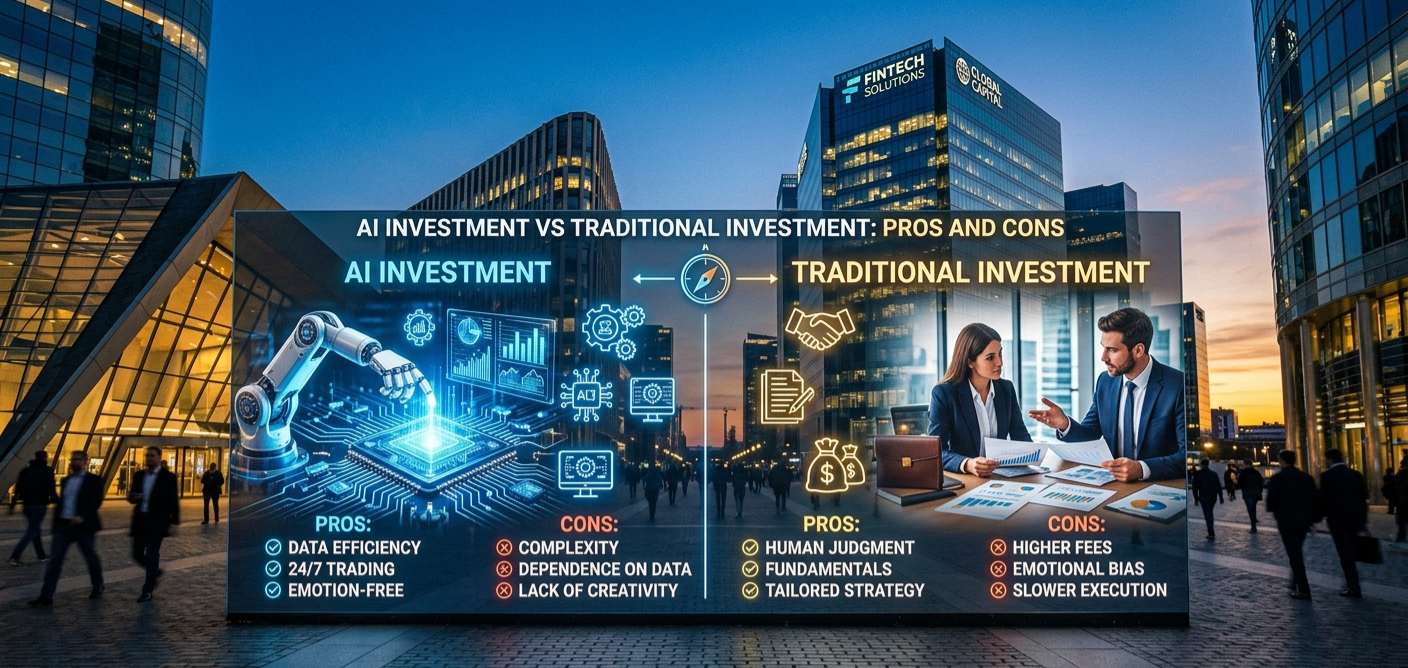
Comparative Analysis: AI vs Traditional Investment
Artificial Intelligence (AI) investment and traditional investment are both popular ways to build wealth, but they differ in growth potential, risk, and market stability. AI investment focuses on advanced technologies like machine learning, automation, and robotics. Major companies such as NVIDIA, OpenAI, and Microsoft are leading the AI industry, attracting investors with strong growth opportunities across healthcare, finance, and cybersecurity sectors.Traditional investment includes assets like real estate, gold, bonds, and established stock markets. These investments are generally more stable and less risky than AI-related investments. While AI investments can generate high returns, they are often more volatile because of rapid technological changes and competition.Traditional investments usually provide steady long-term growth with lower uncertainty. In conclusion, AI investment suits investors seeking innovation and higher returns, while traditional investment is better for those who prefer financial stability and lower risk.